I hurriedly set up the equipment from out of my bags.
'Can I help, señor?' Pedro stepped forwards.
'Please. Undo these two ropes. One has a harness and the other is fixed to this small sack, while I set up the laptop and monitor.'
I then had to think fast. After I had the computer equipment ready, I knelt down at the side of the borehole and felt the walls. Cement.
'Pedro. Are the walls cement all the way down to the bottom? I imagine they're not.'
'These holes are dug with a machine and lower down the walls are just earth.'
So as the child fell, his body brushed against the sides of the hole bringing the earth down on top of him, I thought to myself. Not good.
I turned to Heidi. I had already typed in the programme for her to follow.
'Go, Heidi!'
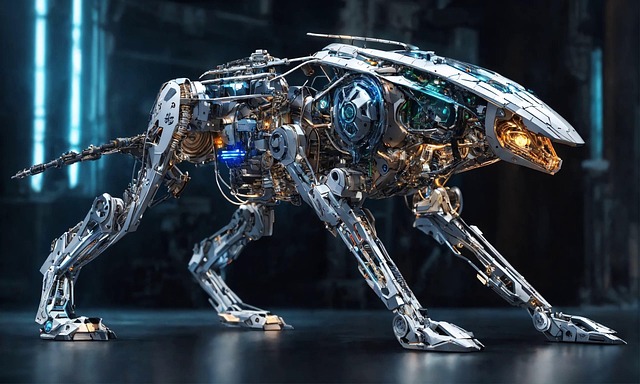
She almost jumped into the hole head first. Even her small body would find it difficult to descend, but she disappeared rapidly into the darkness. Unlike the slow and clumsy articulated robots we usually see, those constructed at my company had the ability to react and move with lively and precise movements.
I looked into the borehole, as did Pedro and the father. I could see Heidi's multiple phosphorescent bulbs on her titanium frame had now lit up. The brightness descended as her feet dug expertly but carefully into the walls of the borehole so as not to disturb the soft soil.
I then turned to the laptop screen and monitor, and Pedro and the father followed. I examined the screen. There was now a crowd of people behind us, silent but impatient. The camera and microphone on Heidi's tail showed her metal frame moving mechanically down metre after metre.
'There's the bag of sweets,' said Pedro pointing at the screen. 'And there's the earth. The tunnel stops there.'
Heidi did not pause. She began digging with great care into the floor. We could hear the sounds over the speakers.
I then picked up the rope with the sack and dropped it into the hole, ensuring that for the last few metres they were lowered slowly.
Heidi now had two feet fixed firmly into the tunnel walls, the camera and microphone on its tail, while the remaining two feet pushed the soft soil into the bag. People crowding behind the monitor, watching, waiting, hardly daring to breathe.
Then it happened. The rest of the earth on the tunnel floor then dropped down showing the head of a small boy.
'Raise the bag of earth, Pedro. Don't let it drop down onto the child!' I shouted.
While Pedro rapidly pulled up seventy metres of rope, I lowered the other rope with the harness.
It was a matter of a few tense minutes, but eventually the harness appeared on the monitor screen. Yet at that moment, something truly amazing was taking place.
During the wait, Heidi had attached a small mask to the boy's face, and a tube then led to a tiny bottle of oxygen visible inside Heidi's frame. The body moved and everybody clearly heard a small cry.
'He's alive!' shouted the father. 'Carlitos is alive!'
'The boy was covered by earth above, but below there must have been an air space so that he could continue to breathe,' I suggested.
We could now clearly see Heidi expertly attaching it to the child's body. Heidi paused. She had no voice but sent a message that appeared on the screen: Pull him up carefully!
Pedro and I both pulled up the rope, and we could see Heidi below the boy holding his legs with her two feet so the body would not come into contact with the tunnel walls and cause another fall of earth.
The boy cried again, and despite this desperate sound - because this meant the boy was alive, people started cheering behind me.
Then Carlitos appeared at the hole entrance with Heidi close behind. An ambulance medic picked him up in her arms.
'I think he's going to be OK,' I understood her to say in Spanish as the mother stroked away the warm tears on his cheeks. 'He is suffering from hypothermia. We'll take him to hospital straight away. The parents can come with us in the ambulance.'
The mother came up to me before she left, and held my two hands in hers. 'Thank you. You are a good man. Thank you so much for everything you have done here.'
'I couldn't have done it without Heidi,' I answered.
We both looked down, but Heidi had collapsed on the ground at my feet, her batteries exhausted, but Sunny, my golden retriever, was looking up at us hoping for some affection. The mother bent down and stroked her head.
'I must go,' she said, and began to walk towards the waiting ambulance.
'Happy New Year!' I called after her.
'Incredible machine you have there, Mr Finnigan.' It was Pedro, the firefighter.
'Thanks,' I answered. 'It did its job today. I developed it as a rescue dog robot to save people buried under collapsed buildings after an earthquake.'
'You must sell a lot of them!'
'Not so. I haven't sold any, Pedro! Buying an expensive robot like this is not profitable. It seems I'm just a dreamer!'
'Nevertheless,' said Pedro. 'You designed and built one at your expense. We are grateful to people like you, Mr Finnigan.'
Copyright © 2026 Practising English
All rights reserved