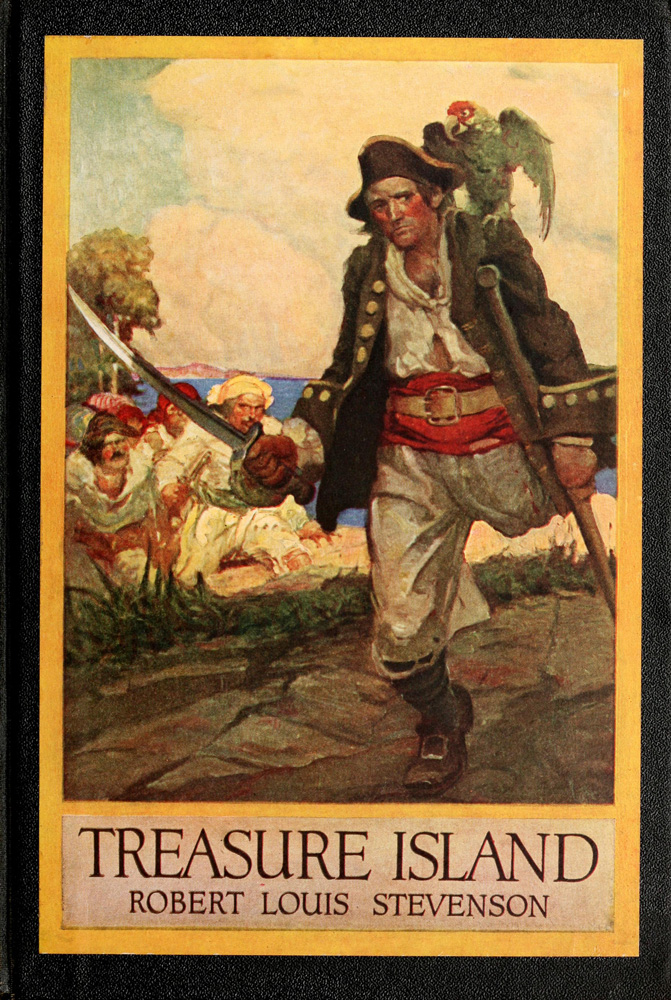
Born in Edinburgh in 1850, Robert Louis Stevenson was very ill as a child, who had a wonderful imagination. He refused to enter into his father’s engineering profession and chose literature instead . He travelled to improve his breathing problems, meeting his wife, Fanny Osbourne, in France. Robert was a well-known Victorian author, he wrote classics like Treasure Island (1883) and Dr. Jekyll and Mr. Hyde (1886). Due to poor health, he moved to Samoa, where he was known as "Tusitala" (teller of stories). He died of a brain haemorrhage in 1894 at age 44, leaving behind much-loved adventure stories still read today.
Squire Trelawney, Dr. Livesey, and some other gentlemen asked me to write down the whole story of Treasure Island, from the beginning to the end . I must leave out only the exact position of the island, because there is still treasure there. So I begin my story in the year 1759, and I go back to the time when my father ran the Admiral Benbow Inn*.
My name is Jim Hawkins. I was only a boy when this story took place – just thirteen years old. I helped my father and mother at the inn, which was accommodation for travellers ; a place to stay and where we also served food.
The Admiral Benbow Inn was on the coast of south-west England, in a tiny village called Black Hill Cove about fifteen miles from the city of Bristol.
It was at this time when the old sailor with a sword cut on his face first came to stay with us.
I remember him very clearly . He came walking slowly to the door of the inn*, and a man followed him with a huge box on a small cart*. He was tall and strong, with brown skin from the sun. His dirty blue coat was old, and his hair was tied in a long tail . His hands were rough, and one cheek had a long, white cut. He looked around the bay while singing quietly to himself. Then he began to sing an old sea song, which he sang many times later:
'Fifteen men on the dead man’s
chest
—
Yo-ho-ho, and a bottle of rum*!'
His voice was high and shook a little, like a voice broken by many years at sea. Then he knocked on the door with a stick and asked my father, in a rough voice, for a glass of rum. He drank it slowly , enjoying the taste , while he looked at the sea and at the sign above the inn*.
'This is a good bay ,' he said at last, 'and a pleasant inn. Do you get many people here, mate ?'
My father said no, there were very few visitors.
'Well then,' said the sailor, 'this is the place for me. Bring my box inside. I’ll stay here for a while. I’m a simple man. I want rum, bacon, and eggs. You can call me captain .' Then he threw some gold coins on the floor. 'Tell me when that money is used up ,' he said with an angry look.
Although his clothes were poor and his speech was rough , he did not look like a common sailor . He looked like a man who was used to giving orders . The man who brought his box told us that the sailor had arrived the day before and had asked for a quiet inn* by the coast . That was all we ever learned about him.
He seemed to be a quiet man. During the day he walked around the bay or stood on the cliffs with a telescope . In the evening, he sat by the fire and drank strong rum* and water. When people spoke to him, he usually did not answer. He only looked up angrily and made a loud noise with his nose. Soon everyone learned to leave him alone .
Every day he asked if any sailors had passed along the road. At first we thought he was lonely , but later we understood that he wanted to stay away from them. If a sailor came to the inn*, the captain would watch him carefully before entering the room and would stay very quiet while the sailor was there.
One day, he pulled me by the arm to a corner of the room and promised to give me a silver coin every month if I would look out for a sailor with one leg . I had to tell him at once if I ever saw such a man. Sometimes he forgot to pay me, but later he always gave me the money and repeated his orders .
The one-legged sailor lived in my dreams. On stormy nights, when the wind shook the house, I saw him in terrible shapes . Sometimes his leg was cut off at the knee , sometimes he had no leg at all . In my nightmares he ran after me, and I woke up full of fear . I paid a high price for that small coin .
Still, I was less afraid of the captain than many other people were. Sometimes he drank too much rum. Then he sang loud and mad songs or forced everyone to listen to his stories. He would not let anyone leave the inn until he was sleepy and went to bed.
His stories were the worst part. They were about cruel punishments , storms , and terrible crimes at sea. My father worried that people would stop coming to the inn, but in fact some visitors liked the excitement . Young men even called the captain a 'true sea-dog' and admired him.
However, the captain destroyed our family. He stayed for weeks and then months without paying. My father was too afraid to ask for more money. When he tried, the captain only looked at him angrily. The fear and worry made my father’s health worse. My father died not long after.
Only once did someone try to stop him. That was Dr. Livesey. One evening the doctor was sitting in the inn when the captain began singing again. The doctor did not like it and spoke calmly to him. When the captain pulled out a knife and moved towards him, the doctor did not move.
'If you do not put that knife away at once ,' said the doctor, 'you will be punished by law .'
They looked hard at each other, but in the end the captain gave in and sat down. After that night, he was much quieter, and for many evenings he sat in silence .
Copyright © 2026 Practising English
All rights reserved